Religious Education
At Pannal, RE (which falls mainly under the ‘Understanding of the World’ area of the EYFS curriculum) starts in the Early Years with children exposed to other cultures and religions around the world. EYFS staff strive to make this learning relevant to the children and to ensure that it is taught sensitively and openly. The children learn about celebrations and cultural events that they take part in in their community, and are also introduced to events that happen throughout the world. Staff make sure to find out about the religions and cultural events that are celebrated by the families in our school to ensure that we can learn about them together. We follow the North Yorkshire Agreed Syllabus, and the children take part in both planned and spontaneous activities. For example, they take part in a Harvest celebration with their Year 6 buddies, they may try foods and make art linked to Diwali, or they may have noticed some special food in the supermarket which leads to a discussion about Chinese New Year.
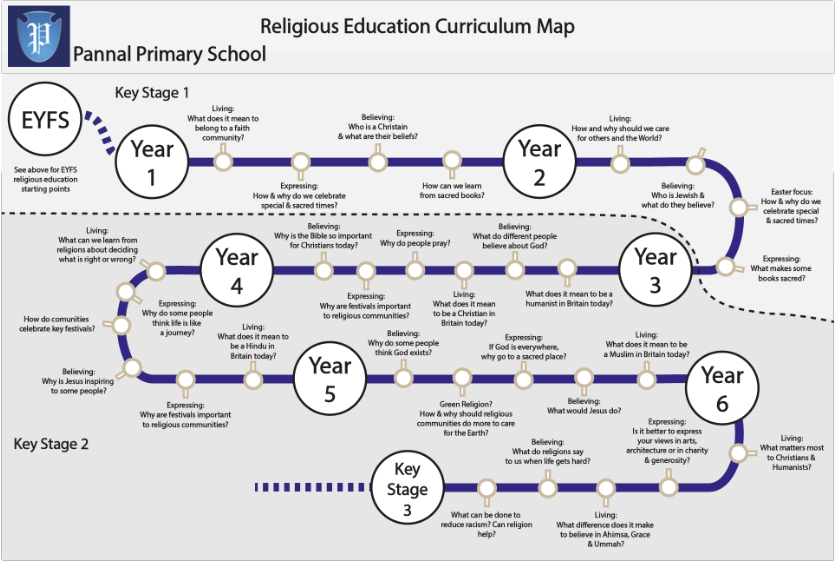
For Key Stage 1 and 2, Religious Education is planned using the North Yorkshire Agreed Syllabus 2024-2029.
Parents may see a copy of this syllabus in school. All children will be involved in a daily act of worship, often known as assembly, which is broadly Christian. Parents may withdraw their child from Religious Education provided that such a request is made in writing to Mrs Wolfram. Alternative provision would then be made following consultation with parents.
What is RE all about?
In RE, we explore big questions about life, people, and the world around us. We learn how different religions and beliefs try to answer these questions, and we think about our own ideas too.
RE helps us to:
-
Understand what others believe and why it matters to them
-
Ask thoughtful questions and listen to different points of view
-
Share our own thoughts and learn from each other
It’s a subject that helps us grow in understanding, kindness, and curiosity.
Key objectives
-
Knowledge and understanding: Pupils will learn about a range of religions and non-religious worldviews, including their beliefs, practices, and how they are expressed.
-
Critical thinking and personal development: The syllabus encourages pupils to analyse information, reflect on challenging questions about identity, meaning, and purpose, and develop their own insights in a reasoned and respectful way.
-
Respect and diversity: It promotes sensitivity and respect for people of all religions and worldviews, with a focus on appreciating diversity and challenging discrimination and racism.
-
Citizenship: The syllabus prepares pupils to be thoughtful citizens who can participate positively in a diverse society.
Learning at a Glance
-
Focus on lived experience: The syllabus emphasises understanding the lived experience of people to make learning about diversity more meaningful.
-
Systematic learning: Learning is sequenced across the key stages, allowing for knowledge to be built upon and deepened over time.
-
Inclusivity: The syllabus includes non-religious worldviews like Humanism, ensuring that different perspectives are represented and respected alongside religious ones.
-
Experiential learning: When possible the RE curriculum is taught through experiences beyond the classroom, such as visits to local places of worship and inviting visitors into school.
Our Way of Learning
-
We aim to be inclusive, inspiring, and thought-provoking, fostering open-mindedness and encouraging children to become respectful and confident individuals.
-
We provide opportunities for deep thinking, which helps secure knowledge and contributes to pupils' moral development by helping them develop empathy and understanding of different perspectives.