History
At Pannal, History (which falls mainly under the Understanding of the World area of the EYFS curriculum) starts in the Early Years with children beginning to understand the idea of time; both in the short term and the long term. This complicated concept is introduced and explored; starting with changes that have happened to them and their families and branching out into changes in the wider world. The children take part in both planned and spontaneous activities. For example, they may learn about the moon landings as a planned topic, they may talk about the life of the monarch when a big news story happens, or they may tell the class about a new baby in the family which leads to a discussion about how we change throughout our lives.
What we hope for our pupils by the time they leave Pannal School
History has an important part to play in our understanding of the world and the societies we live in. We want children to realise how the past has influenced our lives today. Learning about people and events in the past, both in Britain and the wider world, helps children to develop their own values and may influence decisions they make both at present and in the future. We want all children to value their own and other global cultures.
Our history curriculum stimulates a child’s natural desire to investigate. Children are given the opportunity to develop a deeper understanding of the past through carefully planned structured learning investigations and a variety of high-quality provision.
Children experience different periods of history in chronological order and their knowledge is consolidated and extended in each of the periods studied. At the same time, children are developing the key skills of enquiry. The ability to undertake independent research, evaluate and interpret evidence, and justify their own conclusions is seen as essential preparation for the next stage in their learning.
Why we teach what we do We follow the National Curriculum and aim to offer a ‘knowledge-rich, broad and balanced’ curriculum. We plan lessons to stimulate an interest in finding out about the past, encouraging children to ask meaningful questions that will further their understanding and increase their knowledge.
As children move through the school, progression in history is carefully planned and monitored to ensure all children, regardless of their learning needs, can develop skills and knowledge. We provide learning opportunities and differentiated tasks that build upon previous knowledge and achievement. Topics are revisited to ensure that key concepts and facts are stored effectively in a child’s long term memory.
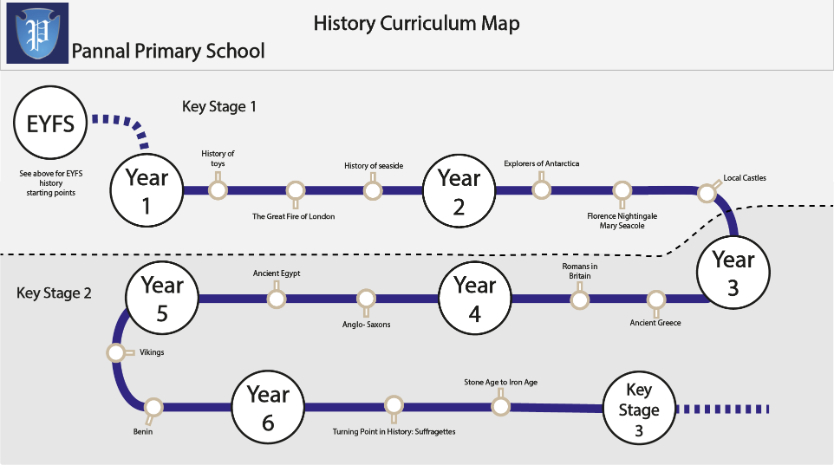
History is taught as a discreet subject from Years 1 to 6 and there is a history focus in each term. The ‘Big Ideas’ in history are addressed in each year group and the topics studied are planned to include the historical concepts of:
- Change and continuity;
- Cause and consequence;
- Similarity and difference;
- Significance and diversity.
History in EYFS is incorporated into learning as the children begin to investigate their own history and that of their family and friends. As well as British and global history, local history is also studied. This reinforces the relevance of History to their lives and their community and further develops a sense of identity and place. Where we live and grow is an important part of who we are.
How history is taught
We share knowledge organisers with the children which provide the key information we want children to learn and retain. Key facts, events, dates and relevant vocabulary are featured. Key vocabulary is introduced, developed and extended for each topic and is revisited regularly. We give time to review learning and use a variety of retrieval activities and quizzes which inform subsequent planning.
We use a variety of teaching and learning strategies with an emphasis on Inquiry-based Learning. We give children a wealth of experiences, from stories and role-play to research projects and lively debate. The learning is enhanced through visits to museums and historical sites; workshops led by experts; visitors; the use of artefacts such as objects, paintings and documents; stories and drama.