Geography
Geography is an important part of children’s understanding of the world and their place in it. If children develop a sense of place, an understanding of the impact our environment has on us, and the impact we have on it, we hope that they will grow up with a sense of awe and wonder about the world they live in and a sense of responsibility to care for it.
Geography offers our children the opportunity to learn about their immediate environment and how we interact with it. We teach children about places both close to home and far away and engage them in thinking about the character of different places, the impact of human and physical features on people, and how places differ from their familiar environments.
How Geography is Taught
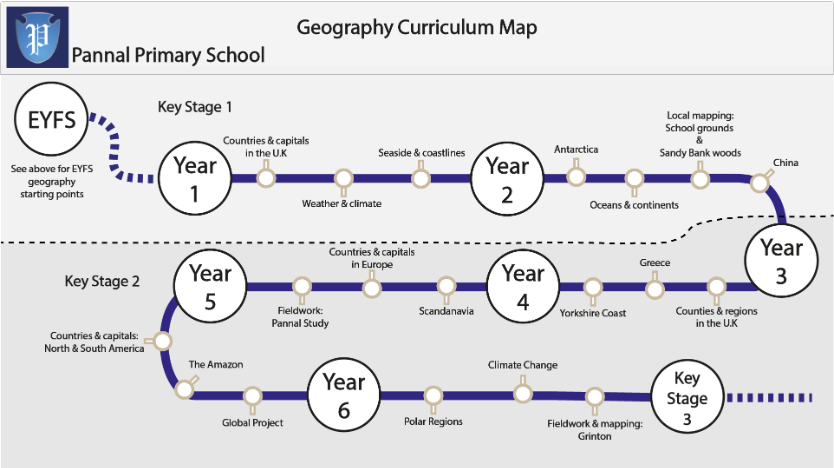
At Pannal, geography begins in the Early Years Foundation Stage (EYFS) as part of the Understanding the World area of learning. Children start by exploring their immediate surroundings — the classroom and playground — before expanding their understanding to the local area, including the woods, the village, and Harrogate. From there, they begin to learn about the wider world where we aim to give the children a breadth of experience of the vast diversity of the world while comparing with their own environment to recognise similarities and differences.
Our geography curriculum is based on the National Curriculum and built around developing key concepts of ‘Place’, ‘Space’, ‘Earth Processes’ and ‘Environment’. These themes are revisited throughout a child’s time at Pannal, helping them build deeper understanding over time. We also focus on developing geographical vocabulary linked to each theme.
Units are carefully sequenced, and we share knowledge organisers with the children. These outline the core information we want them to learn and retain, and we provide opportunities for the children to review their learning, taking time to embed specific knowledge which forms a foundation for subsequent teaching and learning.
Fieldwork and first-hand experience are important parts of our teaching: we make use of the local environment, and the locations of our residential visits, to give the children first-hand experience in new surroundings to carry out fieldwork and consider the human and physical characteristics of places. Maps play an important part of our teaching. Children create their own maps to express their understanding. We use printed maps, satellite imagery, and digital maps throughout the school to help the children develop a sense of place and to recognise how different maps can show different types of geographical information.
Our Vision for Geography
By the time children leave Pannal School, we hope they will have:
- a strong sense of place and identity.
- the ability to articulate their thoughts and feelings about different places and geographical concepts
- a toolkit of geographical skills for gathering and analysing information
- a curiosity about the world and a hunger to learn more about the world in which they live.
Environment Dimension
At Pannal School, we aim to empower children with the knowledge, skills and attitudes they need to deal positively with the changes and uncertainty of the future. By the time they leave us, we hope that they have become confident, connected, lifelong learners with a sense of responsibility for the well-being of their natural environment. We recognise that our children are growing up in a world in environmental crisis. As such, we have a responsibility to provide opportunities for our students to become engaged in real world affairs and begin to understand the complex environmental issues confronting our planet.
When planning our curriculum, we look for natural links in the National Curriculum to embed the Environment Dimension and give children memorable experiences from which they learn about their inter-relationship with the world around them, the impact they have on it and their responsibility to care for it. We plan for outdoor learning opportunities, teach them about the natural environment and promote conservation activities.
We believe that every child should have opportunities to learn outside the classroom. We have a rich and exciting outdoor environment at our school. We use our extensive school grounds and the adjoining woodland regularly as a means of inspiring and stimulating children in their learning and take the children on walks so that we can also use the area within walking distance of the school. In years 5 and 6, the children take part in residential visits which complement their learning in school and give them opportunities to learn more about other areas of Yorkshire.
All year groups make use of the woodland adjacent to school throughout the year for a variety of learning opportunities. This might be regular visits over the course of a term as part of a project, or a single visit as a stimulus for writing, science or art. The children learn to appreciate the natural environment and enjoy these learning opportunities.
Forest School
We have an area of woodland adjacent to the school grounds and direct access to this wonderful learning environment. Currently, all of our Reception, year 2, 5 and 6 children take part in a series of Forest School sessions each term. Through a balance of supported and self-initiated tasks, children learn to appreciate the natural world and their responsibility to care for it. They are taught to use tools safely, assess and manage risks, negotiate and cooperate with each other and value others’ strengths and opinions. Research has shown that Forest School develops children’s confidence, self-esteem and determination to persevere with tasks: attributes which have far reaching benefits. www.foresteducation.org
Climate Action at Pannal Primary School
At Pannal we are committed to creating a more sustainable future for our children. Our Climate Action Plan sets out the steps we will take to help reduce our carbon footprint, adapt our school site and systems to build resilience and enhance the biodiversity of our environment, and develop our curriculum to prepare our children for a world shaped by climate change. Through Forum Families, our whole-school approach to pupil voice, and our Green Team, we aim to empower children to share their ideas and opinions in mixed age groups and be involved in the decision making and direct action necessary to implement change.
Residential Visits in KS2 at Pannal School
Residential Visits are an important part of our Key Stage 2 curriculum at Pannal School. We believe they give the children a wide range of opportunities, which enhance both our curriculum provision for the children and the children’s independence, confidence, resilience, and social skills.
In Key Stage 2 at Pannal School, there are residential visits in years 4, 5 and 6 which each have a different focus, and all complement each other.
Year 4 Sleepover (one night)
In June of Year 4, as an introduction to residential experiences, the children have an overnight sleep-over in school. For some of the children, this is the first time they have stayed away from home. The aims of the visit are to develop the children’s confidence and independence away from home.
Year 5 Carlton Lodge (two nights)
In the autumn term of Year 5, the children spend 2 nights and activity days at Carlton Lodge Outdoor Education Centre at Carlton Miniott near Thirsk. The focus for this visit is:
- to offer the children a range of outdoor adventurous activities
- to encourage them to try new activities
- to help them to recognise their strengths
- to face and try to overcome challenges.
Year 6 Geography/ History Field Trip: Grinton Lodge (4 nights)
In Year 6, the children spend a week (Monday to Friday) at Grinton Lodge YHA in Swaledale. The focus for this visit is geography fieldwork, identifying historical evidence of how the local landscape, and its use, has changed over time, as well as developing the children’s independence and resilience.
We travel to the Lodge by coach and for the rest of the week have no transport until we return to school on Friday. This means a slower pace of life as we visit places in the locality and learn to appreciate staying in a National Park. While there, the children learn about the lead mining history in the valley with the help of the owner of the Swaledale Museum in Reeth who brings history to life. We also study the stream nearby and see first-hand the features of rivers and the effects of the water on the landscape. We walk to the top of Fremington Edge to gain a unique perspective of the valley and the children often feel a profound sense of achievement when they complete the walk.
The children:
- mix with other people across their year group
- enjoy spending time with established friends, and often find new friendships form
- learn to organise themselves, taking responsibility for what they need with them for each day out
- have time to reflect on what they have learned about themselves, others and the location
- learn a wide variety of geography fieldwork skills in a memorable environment
Before and after this visit, the children complete work in school related to the visit and all of this is presented as a project file which gives the children a taste of the type of independent work they might be required to complete at secondary school.
The centres we use have approved supplier status from NYCC’s Educational Visits Advisor giving confidence that everything is in place to cover all Health and Safety requirements. Grinton Lodge is a youth hostel (YHA) and Carlton Lodge holds the AALA licence from the Adventurous Activities Licensing Service.
‘Safeguarding children is our priority, and we work closely with industry leading experts, including the DBS and the NSPCC, to ensure that our child safeguarding practices are over and above those required by law. All properties are regularly inspected for their physical safety and security,’ YHA.
We hope that this gives you an appreciation of what we aim to achieve through the residential experiences that we offer at Pannal. We hope you will encourage your children to participate. We spend a lot of time preparing the children for these visits and talking to them about their excitement and apprehension and encouraging them to support each other. As we all know from experience, new situations are challenging but also very worthwhile. Please encourage your child(ren) to grasp these opportunities and grow through their learning.
We pride ourselves on keeping parents well informed about any residential in which their child(ren) will participate but if you have any questions, please do not hesitate to discuss with your child’s class teacher or the educational visits coordinator.