Science
At Pannal, Science (which falls mainly under the Understanding of the World area of the EYFS curriculum) starts in the Early Years with children exploring the world around them. Children will have the opportunity to take part in scientific exploration daily as it is an integrated part of the EYFS learning environment. The children take part in both planned and spontaneous activities. For example, they may learn about changing states of matter whilst making pancakes, they may begin to learn about forces whilst using the cars and the drainpipes to make ramps, or they may notice that the lights come on when somebody moves which leads to a discussion about electricity.
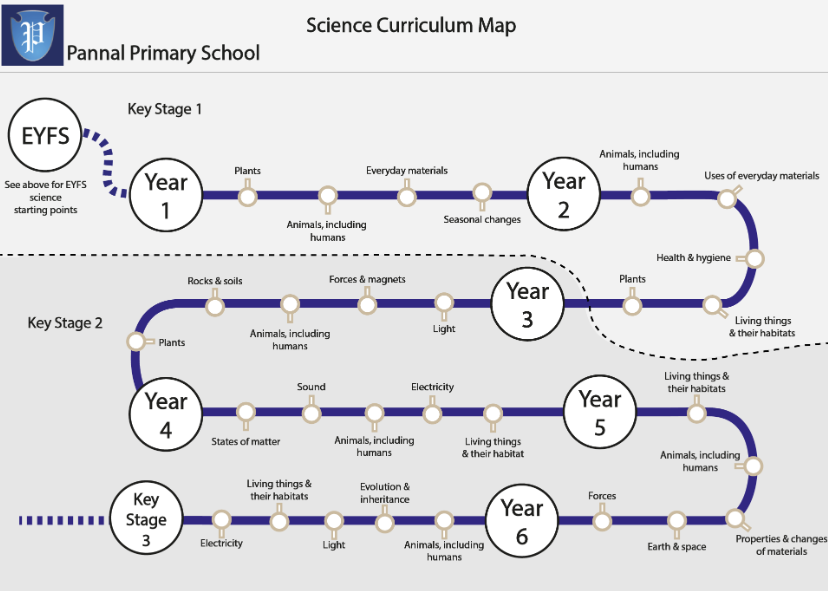
Throughout Key Stage 1 and 2 we see the teaching of science as a vital way for the children to develop their understanding of the world in which they live. We place great value on outdoor learning; working outdoors teaches the children to respect their environment and begin to understand the complexity and relative fragility of the natural world.
The children learn specific scientific vocabulary so that they can accurately explain their understanding of the concepts studied. Knowledge organisers, which have the key knowledge and scientific vocabulary we want the children to retain, are used for each unit of work. Regular revision of vocabulary and low-stakes quizzes are used to ensure that this knowledge is being secured.
We believe that exciting and engaging practical investigations are key to deepening our children’s scientific knowledge, skills and conceptual understanding. We ensure that all children are exposed to various ways of working scientifically whilst introducing and developing scientific concepts. They become familiar with five types of scientific enquiry: observing over time; pattern seeking; identifying, classifying and grouping; comparative and fair testing; and researching using secondary sources.
We are fortunate to be able to make regular use of the woods next to our school, as well as the natural spaces around our grounds, to provide an abundance of scientific opportunities. These experiences provide a meaningful context and relevance to their learning. Science is taught discretely, but links are made to other areas of the curriculum wherever possible. In Key Stage One, for example, knowledge gained by first-hand experiences of the changing seasons in the woods is linked to report writing in literacy. In year six, during the summer term, pupils learn about living things in their habitats while working towards their John Muir Award.